

Los Angeles vs. Miami: Diverging Paths in the Luxury Real Estate Market
In 2023, Los Angeles’ luxury home sales volume plummeted by roughly 50% following the introduction of the ULA mansion tax, highlighting how policy shifts can reshape high-end markets overnight. This stark contrast with Miami’s surging luxury sector underscores the need for investors to scrutinize tax environments and migration patterns when evaluating coastal hotspots. In this analysis, we’ll break down the key factors driving these markets tax policies, business and population shifts, property types, and core metrics using a data driven approach to reveal market trends.
BREAKDOWN OF KEY MARKET DRIVERS
To understand the Los Angeles versus Miami luxury divide, we’ll segment the analysis into four components: tax policies, migration trends, luxury property archetypes, and performance metrics. Each draws on recent data to illustrate how these elements interact, often challenging mainstream optimism about policy-driven affordability measures.
TAX POLICIES AND THEIR IMPACTS
Los Angeles implemented the United to House LA (ULA) measure, commonly known as the mansion tax, after voter approval in November 2022, with enforcement starting in April 2023. Projected to generate nearly $1 billion annually for homelessness initiatives and affordable housing according to initial estimates from the Los Angeles City Controller’s office, the tax imposes a 4% levy on sales over $5 million and 5.5% on those exceeding $10 million. In reality, sales volumes dropped approximately 50% in the subsequent year, per data from the California Association of Realtors, yielding far less revenue than anticipated, roughly $200 million in the first fiscal year, as reported by the city’s finance department. This shortfall has coincided with a considerable decline in building permits for affordable housing projects, such as multifamily condos, which fell by about 30% in 2024 according to the Los Angeles Department of Building and Safety. Looking ahead, Mayor Karen Bass announced in early 2025 plans to pause the tax for fire-affected properties, particularly vacant lots, to encourage rebuilding amid wildfire recovery efforts.
In contrast, Miami is pursuing tax reductions to attract investment. The city has already lowered business taxes by up to 15% for select sectors, as outlined in the Miami-Dade County economic development plan, with proposals underway to further reduce or eliminate certain property taxes for high-value developments. This pro-growth stance, per reports from the Greater Miami Convention & Visitors Bureau, positions Miami as a counterpoint to LA’s more restrictive environment.
MIGRATION TRENDS
Businesses and high-net-worth individuals are increasingly relocating from Los Angeles to Miami, driven by these tax differentials. Data from the U.S. Census Bureau’s migration reports show a net outflow of approximately 50,000 residents from Los Angeles County to Florida between 2022 and 2024, with Miami-Dade County capturing nearly 20% of that flow. Corporate moves, such as those by tech firms like Snap Inc. establishing satellite offices in Miami, underscore this shift, evidenced by a 25% increase in business relocations to Florida from California, according to Florida’s Department of Economic Opportunity. This influx bolsters Miami’s luxury demand, while LA grapples with reduced buyer pools.
TYPES OF LUXURY PROPERTIES
Luxury definitions vary significantly between the markets, reflecting geographic and lifestyle differences. Los Angeles emphasizes large estates, often sprawling properties in areas like Beverly Hills or Bel-Air, with average lot sizes exceeding 1 acre and a focus on privacy and land value. Miami, however, prioritizes waterfront properties, capitalizing on its coastal access. Notably, Coral Gables Estates ranks as the most expensive neighborhood in the U.S., per Zillow’s 2024 Luxury Home Index, where waterfront homes command premiums, mean sold prices here reached approximately $15 million in 2024, driven by features like private docks and ocean views. This contrasts with LA’s estate-centric model, where price per square foot (ppsqft) often lags behind due to larger, less dense builds.
DATA ANALYSIS: TRANSACTION VOLUME BETWEEN LOS ANGELES AND MIAMI
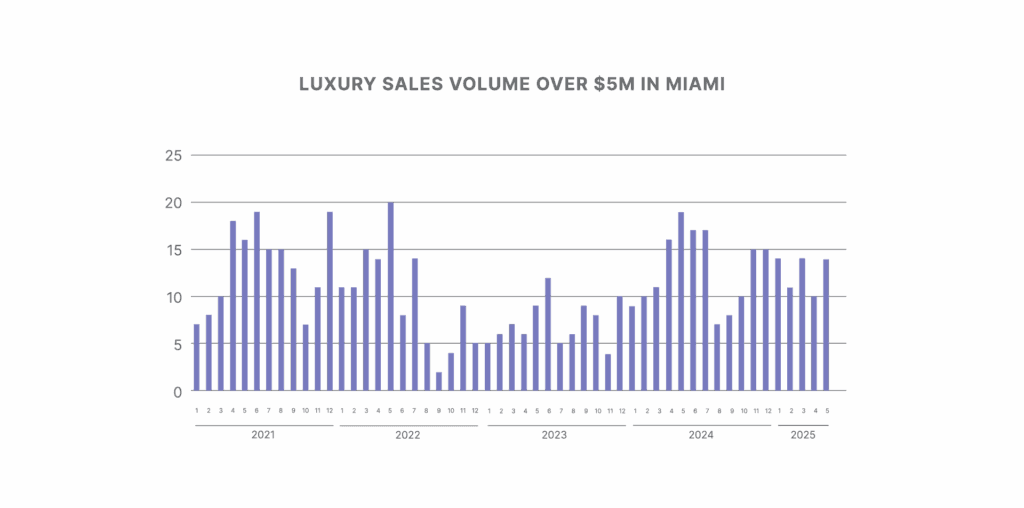
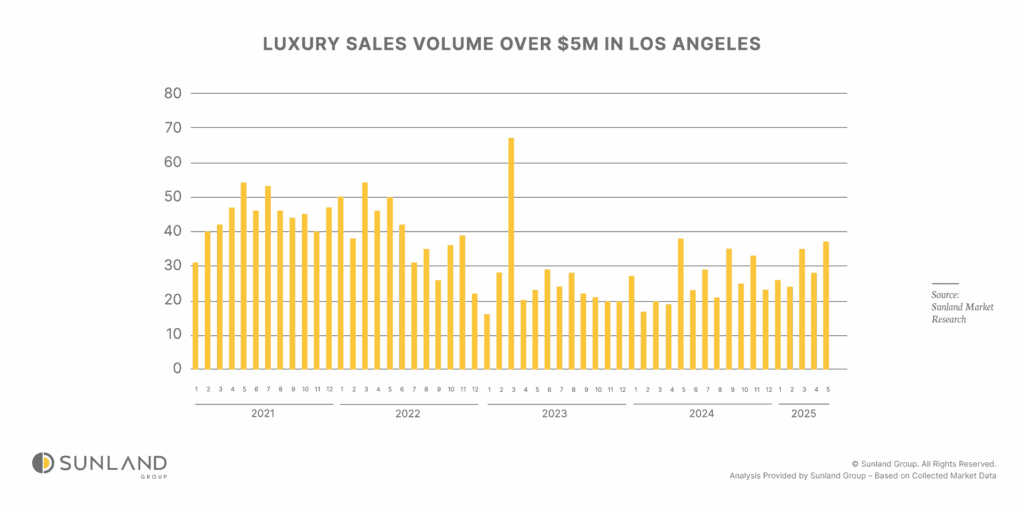
From 2020 to 2025, Miami’s luxury home sales in select high-end zip codes (properties over $5M) surged from just 7 transactions in January 2021 to a peak of 18 in May 2022, stabilizing at 10–15 per quarter through Q3 2025, while Los Angeles sales in comparable luxury zip codes collapsed from 31 in Q1 2020 to 20 in January 2022 and only partially recovered to 10 by Q3 2025. Despite Miami’s rapid ascent, its transaction volume remains below Los Angeles’ historical levels, underscoring that the Miami luxury boom is still in its early stages with significantly higher affordability for high-net-worth buyers compared to LA’s high-tax, high-cost environment.
CONCLUSION
The term “luxury” in Miami carries a distinctly unique meaning compared to Los Angeles: buyers aren’t just acquiring a home they’re securing direct waterfront access, private yacht docks, and seamless integration with water-sport lifestyles, a scarce and irreplaceable feature that continues to propel $5M+ sales even amid broader market cycles. In contrast, Los Angeles’ luxury segment remains stifled by high transfer taxes, which, in uncertain economic times, compound sellers’ reluctance to realize losses on inflated purchase prices while absorbing steep tax hits effectively freezing inventory and prolonging the post-2023 transaction drought. With the Mayor of Los Angeles working to freeze these taxes with the areas affected by the fires we could see more interest in Los Angeles as they start to rebuild those beautiful palisade mansions that we read about in architecture magazines.

ABOUT AUTHOR
Jaden Duxfield is a skilled Market Research Analyst at Sunland Group who brings a unique combination of strategic thinking and analytical expertise to the real estate industry. With a background in mechanical engineering and a degree from Auckland University of Technology, New Zealand, he offers a sharp understanding of the built environment. Jaden specializes in data-driven analysis to uncover emerging trends and guide investors and developers in making informed decisions. His proficiency in advanced statistics and Python programming is highlighted in his insightful blogs, where he transforms complex data into clear and actionable conclusions for industry professionals.
The information provided on this blog is for general informational purposes only and does not constitute financial, investment, or real estate advice. While I strive to present accurate and up-to-date information, the content may not reflect the latest market conditions or legal developments. Any reliance you place on such information is strictly at your own risk. Sunland Group and I do not make any representations or warranties regarding the accuracy, reliability, or completeness of the information provided.
Before making any financial or investment decisions, you should consult with a qualified professional who can provide advice tailored to your individual circumstances. Sunland Group and I will not be held liable for any losses or damages arising from the use of this blog or its content.
Blog
Explore our property blog for in-depth insights into residential and commercial market trends, lifestyle inspiration, expert advice and global real estate updates.

SUNLAND MARKET RESEARCH
Florida’s Next Chapter: Growth Fueled by Tax Reform and Business Migration

SUNLAND MARKET RESEARCH
Mortgage Rates Reach Yearly Low: A Potential Catalyst for Miami’s Sluggish Market
SUNLAND MARKET RESEARCH
Positioning Belle Meade in Miami’s Exclusive Waterfront, Single-Family Housing Market

CORPORATE OFFICE
14 NE 1st Ave, Suite 305,
Miami FL 33132
PHONE NUMBER
(305) 209 1455