

Florida Real Estate Market 2025: Summary, Highlights, and What’s Next
As 2025 draws to a close, Florida’s real estate market has navigated a year of notable transitions, shaped by macroeconomic pressures, shifting buyer sentiment, and the state’s enduring appeal. The year began amid uncertainty, with the implementation of new tariffs under the Trump administration prompting a more cautious Federal Reserve stance on interest rates. Delays in rate cuts intended to offset potential inflationary impacts from trade policies created tension and heightened economic unpredictability, weighing on consumer confidence and sidelining many would-be buyers in the housing sector.
Despite these headwinds, Florida’s core strengths shone through: sustained population growth (approaching 23.4 million residents), no state income tax, and ongoing corporate relocations continued to draw newcomers and businesses seeking a favorable environment. Median home prices stabilized around $408,000–$411,000 statewide, reflecting modest declines or flat growth in many areas compared to prior peaks. Inventory levels rose significantly reaching 5–6 months’ supply in much of the state shifting several markets toward buyer-friendly conditions, with homes lingering longer on the market and often selling closer to or below asking price.
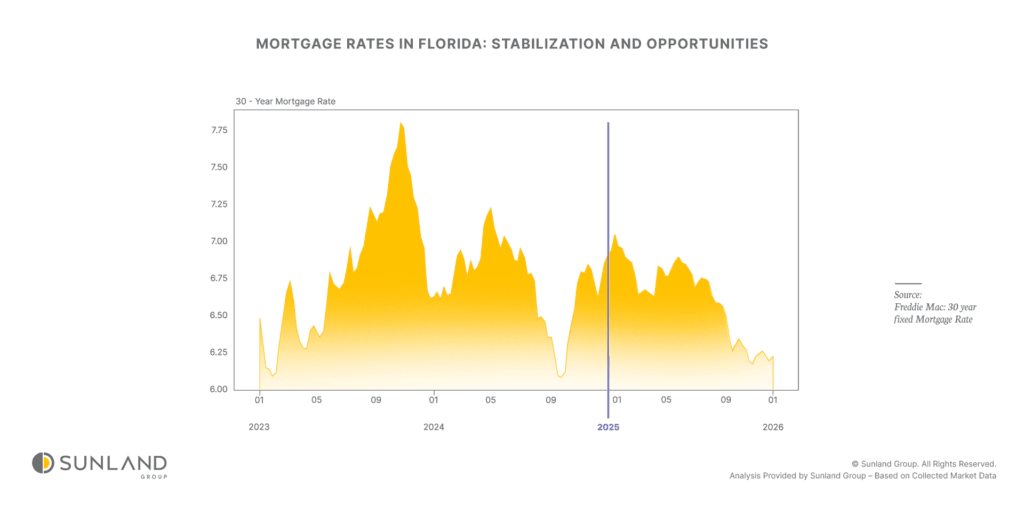
One of the biggest stories in Florida’s 2025 real estate market has been the stabilization of mortgage rates after years of volatility. According to Freddie Mac’s Primary Mortgage Market Survey, average 30-year fixed rates hovered between 6.2% and 6.8% throughout the year, a welcome drop from the 7%+ peaks of 2023-2024. This moderation, driven by the Federal Reserve’s cautious rate cuts in response to cooling inflation, has boosted buyer confidence, especially in high-demand areas like South Florida.
For Floridians, this meant more affordable borrowing, with first-time buyers and families benefiting the most. In cities like Miami and Fort Lauderdale, where median home prices sit around $550,000 (per Zillow’s 2025 data) lower rates translated to a monthly savings of $200-$300 on a typical loan payment. Investors also jumped in, snapping up properties for short-term rentals amid tourism rebounds.
Key highlights:
- Rate Trends: Started the year at 6.9%, dipped to 6.18% mid-year, and ended around 6.22% due to election-year uncertainties.
- Impact on Buyers: Affordability improved by 10-15% for middle-income households, per NAR reports.
- Tips for 2025 Buyers: Lock in rates early if you’re pre-approved—consider adjustable-rate mortgages (ARMs) for short-term holds, but consult a lender to avoid surprises.
If rates continue this trajectory, 2025 could mark the turning point for a more buyer-friendly market statewide.
Construction Costs: Rising but Easing Pressures
Construction costs in Florida have been a mixed bag in 2025, influenced by lingering supply chain issues, labor shortages, and material price fluctuations. Data from the Associated General Contractors of America shows a national average increase of 5-7% in building costs, but Florida saw slightly higher spikes around 8% due to hurricane recovery demands and strict building codes post-Ian and Idalia.
In booming areas like Central Florida (Orlando and Tampa), costs for new single-family homes averaged $150 – $200 per square foot up from $140 in 2024. Lumber and concrete prices stabilized mid-year, thanks to improved global supply, but skilled labor shortages added 10-15% to budgets. On the bright side, green building incentives from state programs helped offset some expenses for eco-friendly projects.
Highlights to note:
- Material Breakdown: Steel and lumber costs rose 6%, while electrical components jumped 9% due to tech integrations like smart homes.
- Regional Variations: South Florida faced higher costs (up to $220/sq ft) from flood-resistant requirements, while North Florida saw more moderation.
- Builder Advice: If you’re planning a custom build, factor in a 10% contingency for delays. Look into modular construction, which cut costs by 15-20% for many projects in 2025.
Overall, while costs remain elevated, easing inflation and federal infrastructure funding could make 2026 more builder-friendly.
Single-Family Homes: Demand Drives Steady Growth
Single-family homes continued to dominate Florida’s 2025 market, with strong demand from families, retirees, and remote workers flocking to suburbs and coastal towns. Florida Realtors reported a 4% year-over-year increase in median prices, reaching $425,000 statewide as opposed to $410,000 in 2024. Inventory levels improved slightly to 3.5 months’ supply (from 2.8 months), giving buyers more options without the frenzy of previous years.
In hotspots like Jacksonville and Sarasota, sales volume rose 7%, fueled by job growth in tech and healthcare. First-time buyers found opportunities in affordable enclaves, while investors targeted flips in recovering post-hurricane areas. However, insurance premiums remained a hurdle, averaging $3,500 annually a 10% hike from 2024, per Insurance Information Institute data.
Top trends:
- Pros for Buyers: More listings in family-oriented neighborhoods, with features like home offices and pools in high demand.
- Challenges: Rising HOA fees in gated communities, up 5-8%.
- Investment Tip: Focus on energy-efficient homes; they sold 15% faster and at a 5% premium, according to Redfin’s 2025 analysis.
Single-family homes proved resilient, offering stability for long-term owners amid market shifts.
Condos: Market Adjustments and Buyer Caution
The condo market in Florida experienced turbulence in 2025, with median prices stabilizing at $325,000 a modest 2% increase from 2024, per Zillow. Sales dipped 3% early in the year due to high insurance costs and stricter reserve requirements following past condo collapses. However, urban areas like Miami and Fort Myers saw a rebound in luxury units, driven by international buyers and empty-nesters.
Condo inventory climbed to 4.2 months’ supply, providing bargaining power for buyers. Features like waterfront views and amenities remained hot, but associations grappled with funding major repairs, leading to special assessments averaging $5,000 per unit.
Key insights:
- Buyer Perks: Lower entry prices compared to single-family homes, ideal for retirees or investors.
- Drawbacks: Maintenance fees rose 7%, and financing became trickier with lender scrutiny on building reserves.
- Market Movers: Eco-friendly condos with solar panels fetched 10% higher rents, per Apartment List data.
Despite challenges, condos offered value for those seeking low-maintenance living in Florida’s vibrant cities.
House Bill 913: New Reforms Shaping Florida’s Real Estate Landscape
Introduced in early 2025, House Bill 913 (officially the “Florida Affordable Housing and Insurance Reform Act”) aimed to address two pressing issues: housing affordability and skyrocketing insurance premiums. Sponsored by state legislators in response to ongoing hurricane risks and population growth, the bill passed mid-year and introduced key changes effective from July 2025.
At its core, HB 913 provides tax incentives for developers building affordable units (under $300,000) and mandates insurance companies to cap rate hikes at 5% annually for qualifying properties. It also expands flood mitigation grants, helping condo associations fund reserves without burdensome assessments. According to the Florida Legislature’s analysis, this could add 50,000 affordable units statewide by 2027.
Impacts so far:
- For Buyers/Sellers: Reduced closing costs on eligible homes, saving 2-3% on transactions.
- Investor Angle: Incentives for multifamily developments, boosting rental supply in high-growth areas like Orlando.
- Potential Downsides: Some critics argue it increases bureaucratic hurdles for small builders.
- Expert Take: This bill is a game-changer for first-time buyers’ pair it with low-down-payment programs for maximum savings.
HB 913 underscores Florida’s commitment to sustainable growth, making real estate more accessible.
Looking Ahead: Predictions for the 2026 Florida Real Estate Market
As we wrap up 2025, the Florida real estate market shows signs of balanced growth, with inventory easing and affordability improving. Summarizing the highlights: mortgage rates stabilized around the low-6% range after periodic drops throughout the year, construction costs rose but moderated, single-family homes drove demand, condos adjusted to new realities, and HB 913 injected much-needed reforms.
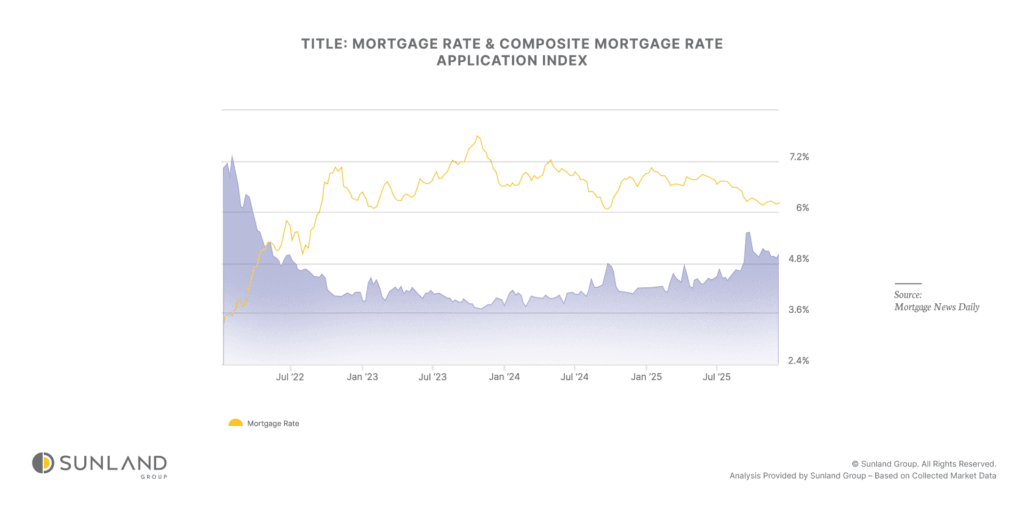
Notably, mortgage applications particularly for home purchases have increased significantly in 2025, with surges in purchase activity reaching the highest levels since early 2022 in recent months, driven by declining mortgage rates that have made borrowing more attractive and signaled strengthening buyer demand.
For 2026, I predict continued momentum. Mortgage rates could dip below 6% if inflation stays low, per Fed projections, spurring a 5-7% sales increase. Construction costs might ease further with supply chain recoveries, potentially lowering new home prices by 3-5%. Single-family homes will remain king, with suburban expansions in Central and North Florida. Condos could see a surge if insurance reforms take hold, reducing premiums by 10%. If rates continue dropping as expected, the upward trend in mortgage applications this year positions 2026 for a strong rebound in real estate activity across Florida.

ABOUT AUTHOR
Jaden Duxfield is a skilled Market Research Analyst at Sunland Group who brings a unique combination of strategic thinking and analytical expertise to the real estate industry. With a background in mechanical engineering and a degree from Auckland University of Technology, New Zealand, he offers a sharp understanding of the built environment. Jaden specializes in data-driven analysis to uncover emerging trends and guide investors and developers in making informed decisions. His proficiency in advanced statistics and Python programming is highlighted in his insightful blogs, where he transforms complex data into clear and actionable conclusions for industry professionals.
The information provided on this blog is for general informational purposes only and does not constitute financial, investment, or real estate advice. While I strive to present accurate and up-to-date information, the content may not reflect the latest market conditions or legal developments. Any reliance you place on such information is strictly at your own risk. Sunland Group and I do not make any representations or warranties regarding the accuracy, reliability, or completeness of the information provided.
Before making any financial or investment decisions, you should consult with a qualified professional who can provide advice tailored to your individual circumstances. Sunland Group and I will not be held liable for any losses or damages arising from the use of this blog or its content.
Blog
Explore our property blog for in-depth insights into residential and commercial market trends, lifestyle inspiration, expert advice and global real estate updates.
SUNLAND MARKET RESEARCH
Los Angeles vs. Miami: Diverging Paths in the Luxury Real Estate Market

SUNLAND MARKET RESEARCH
Florida’s Next Chapter: Growth Fueled by Tax Reform and Business Migration

SUNLAND MARKET RESEARCH
Mortgage Rates Reach Yearly Low: A Potential Catalyst for Miami’s Sluggish Market

CORPORATE OFFICE
14 NE 1st Ave, Suite 305,
Miami FL 33132
PHONE NUMBER
(305) 209 1455