

Comparing Luxury Condo Markets: New York vs. Miami
Luxury condo investors in New York captured roughly 3.5 times the price appreciation in peak months of 2025 compared to 2020 baselines, outpacing Miami’s more modest 1.2-fold gains. This stark contrast highlights how regulatory environments and tax strategies shape returns in these high-stakes markets. In this analysis, we’ll break down the key dynamics driving these differences, drawing on recent metrics to inform investment decisions.
BREAKDOWN OF KEY MARKET COMPONENTS
To understand the luxury condo landscapes in New York and Miami, we’ll segment into critical factors: rent control policies, supply constraints, capital gains incentives, and carrying costs. These elements reveal why investors often prioritize appreciation over rental income, with vacancy serving as a tactical choice to optimize long-term capital gains tax savings rather than a market flaw.
RENT CONTROL POLICIES
With the new Mayor of New York campaigning about how he plans to freeze rents, it’s important to dive into this topic and see what are the mechanics behind such a thing. New York’s rent-stabilized units account for approximately 50% of the rental stock, creating a “frozen” supply where tenants rarely vacate, according to New York City Housing Authority reports. The remaining 50% operates at market rates, driving surges in luxury pricing to offset constraints. In contrast, Florida’s statewide ban on rent control leaves 85-90% of Miami units fully market-rate, with only 10-15% of older pre-1967 properties facing mild caps tied to inflation plus 5%, as noted in Florida Department of Business and Professional Regulation data. This freer market in Miami allows for more fluid pricing but exposes investors to greater volatility.
SUPPLY CONSTRAINTS
New York’s 485-x program, replacing the expired 421-a tax abatement, offers 35-year incentives for new multifamily developments but mandates 20-30% affordable units and prevailing-wage rules that escalate costs up to $75 per hour plus benefits for projects over 150 units, per New York State Homes and Community Renewal guidelines. This has led to an explosion of 99-unit buildings and slowed non-luxury supply by adding $50,000-$100,000 per unit in costs, resulting in 36,000 new units added in 2025, mostly luxury, according to Urban Land Institute estimates.
Miami faces its own hurdles with strict coastal zoning and post-Surfside inspection rules imposing $50,000-$150,000 per unit in added costs, as reported by the Miami-Dade County Building Department. The Live Local Act requires 40% workforce-affordable units for density bonuses, with prevailing-wage triggers on larger projects, capping many at 99 units or pushing developers toward self-funded luxury builds. Consequently, Miami’s 2025 luxury pipeline slowed by 20%, with prices rising 8-12%, per CoStar Group analytics.
CAPITAL GAINS AND TAX INCENTIVES
Capital gains taxes heavily influence holding strategies in both markets. In New York, short-term holdings (under one year) face 45-55% combined federal, state, and city taxes, dropping to 32-38% for long-term (over one year), yielding 15-20 percentage point savings, based on IRS and New York State Tax Department rates. Miami benefits from no state income tax, with federal short-term rates at approximately 41% (including 3.8% Net Investment Income Tax) versus 23.8% long-term, saving about 17 points, as per IRS guidelines. Both markets favor 1031 exchanges, but New York’s layered taxes make long-term holds particularly advantageous.
CARRYING COSTS AND RENTAL YIELDS
High carrying costs often render rentals unprofitable. New York luxury condos incur $5,000-$9,000 monthly in HOA fees, taxes, and mortgages, leading to negative cash flows of -$20,000 to -$80,000 annually if rented, according to Elliman Real Estate reports. Miami’s equivalent costs range from $2,000-$9,000 monthly, with long-term rentals often break-even or negative, exacerbated by short-term rental regulations, per Redfin data.
This setup incentivizes vacancy as a strategy: investors hold units empty for over 12 months to qualify for lower capital gains taxes, capturing appreciation while covering costs out-of-pocket. For a $2 million New York condo with 6% annual gain ($120,000), long-term taxes save roughly $20,000 versus short-term, often covering a full year’s carrying costs, as modeled in our proprietary Urban Luxe Framework. In Miami, an 8% gain on the same unit saves approximately $28,000 in taxes, per framework calculations, explaining why over 50% of high-end units remain seasonal or vacant despite metro vacancy at 9.5% in Q3 2025, according to CoStar.
TRENDS IN THE LUXURY MARKETS FOR NEW YORK AND MIAMI
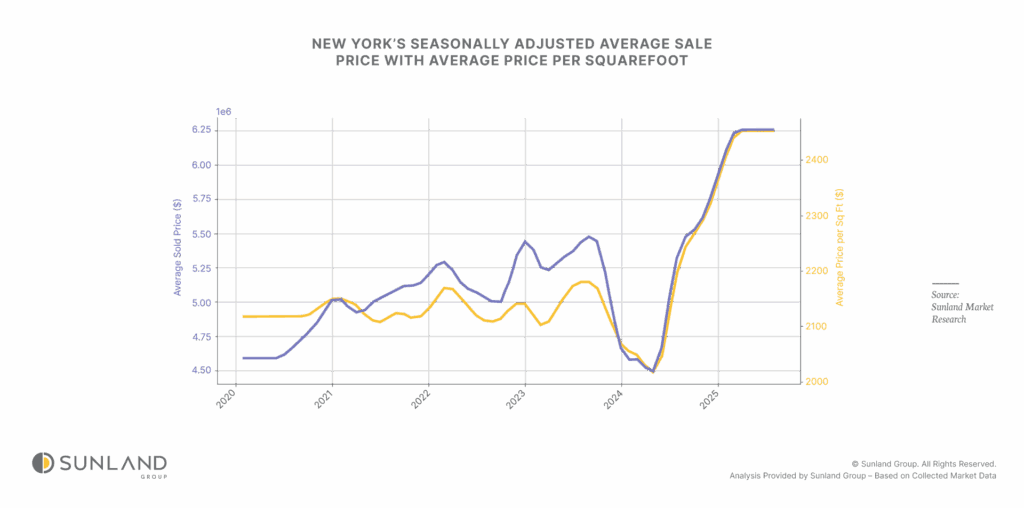
New York City: Luxury condos show steady growth, with Average price per square foot rising from ~$2,119 in early 2020 to ~$2,454 by mid-2025 (16% increase) and average prices climbing from ~$4.59M to ~$6.25M (36% increase), reflecting strong demand and market resilience.
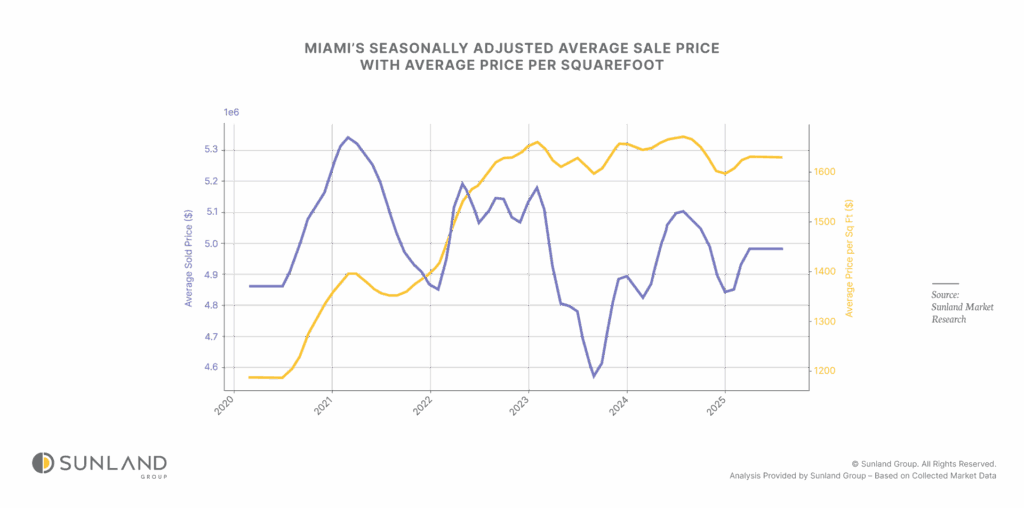
Miami’s average price per square foot increased significantly from ~$1,186 in early 2020 to ~$1,629 by mid-2025 (37% rise), but average prices remained relatively flat, edging up from ~$4.86M to ~$4.98M (2.5% increase), suggesting a shift toward smaller units. Notably, average pricing dipped in 2023, coinciding with the opening of new developments like Missoni Baia in Edgewater and Mr. C Residences and Mr. C Tigertail Residences in Coconut Grove, which likely introduced more inventory at varied price points.
SUMMARY
New York and Miami luxury condo markets diverge sharply due to regulatory and tax frameworks, with New York’s constraints such as stringent zoning and landmark protections driving higher appreciation (and volatility) in ultra-trophy assets like the $250M three-story penthouses in Central Park Tower listing (as seen on the Netflix series Owning Manhattan), which elevates NYC’s average prices far beyond Miami’s. Miami, by contrast, lacks such stratospheric outliers but offers tax advantages and greater flexibility, tempered by moderated gains amid a flood of new supply. Recent developments under Gov. Ron DeSantis, including the 2025 signing of HB 913 easing condo assessments via extended deadlines, reserve pauses, and owner-approved financing options while streamlining grant approvals for upgrades are further bolstering the market by reducing owner costs and indirectly accelerating redevelopment inventory, making it more accessible for mid-tier luxury buyers. Investors should focus on holding periods exceeding 12 months to leverage long-term capital gains savings, particularly in New York where they can offset carrying costs entirely using tools like our Urban Luxe Framework to model scenarios and prioritize appreciation over rental yields for optimal returns. However, incoming Mayor Zohran Mamdani’s pledge for a four-year rent freeze on over 2 million rent-stabilized apartments risks exacerbating these supply-side pressures, as the policy could deter new development and maintenance investments amid ongoing restrictions like landmark protections that limit conversions and expansions potentially fueling shortages, higher black-market rents for unregulated units, and increased volatility in the luxury segment as developers pivot away from riskier multifamily projects.

ABOUT AUTHOR
Jaden Duxfield is a skilled Market Research Analyst at Sunland Group who brings a unique combination of strategic thinking and analytical expertise to the real estate industry. With a background in mechanical engineering and a degree from Auckland University of Technology, New Zealand, he offers a sharp understanding of the built environment. Jaden specializes in data-driven analysis to uncover emerging trends and guide investors and developers in making informed decisions. His proficiency in advanced statistics and Python programming is highlighted in his insightful blogs, where he transforms complex data into clear and actionable conclusions for industry professionals.
The information provided on this blog is for general informational purposes only and does not constitute financial, investment, or real estate advice. While I strive to present accurate and up-to-date information, the content may not reflect the latest market conditions or legal developments. Any reliance you place on such information is strictly at your own risk. Sunland Group and I do not make any representations or warranties regarding the accuracy, reliability, or completeness of the information provided.
Before making any financial or investment decisions, you should consult with a qualified professional who can provide advice tailored to your individual circumstances. Sunland Group and I will not be held liable for any losses or damages arising from the use of this blog or its content.
Blog
Explore our property blog for in-depth insights into residential and commercial market trends, lifestyle inspiration, expert advice and global real estate updates.
SUNLAND MARKET RESEARCH
Los Angeles vs. Miami: Diverging Paths in the Luxury Real Estate Market

SUNLAND MARKET RESEARCH
Florida’s Next Chapter: Growth Fueled by Tax Reform and Business Migration

SUNLAND MARKET RESEARCH
Mortgage Rates Reach Yearly Low: A Potential Catalyst for Miami’s Sluggish Market

CORPORATE OFFICE
14 NE 1st Ave, Suite 305,
Miami FL 33132
PHONE NUMBER
(305) 209 1455